

Is My Money Safe in the Bank 2023?
As we enter a new year, many people are asking “is my money safe in the bank?” We’re post pandemic and catastrophic lockdowns, but now dealing with the rising cost of energy, double digit inflation, and an economic future that looks uncertain. It’s only natural to worry about the safety of your money held in the banks. In this article, we’ll explore the measures in place to protect your money, the risks of keeping fiat currency in a bank, and the benefits of investing in physical gold and silver to protect your wealth.
Before we get into it, I believe it’s important to differentiate the difference between money and currency. Words have meanings and it’s wise to have an understanding of them:
What is Money?
Money is a medium of exchange that is widely accepted in transactions for goods, services, or payment of debts. It can take various forms such as coins, banknotes, digital currency, or other types of financial instruments.
The primary functions of money are as a store of value, a unit of account, and a medium of exchange.
- As a store of value, money is used to save wealth and preserve purchasing power over time.
- As a unit of account, it is used to measure and compare the value of goods and services.
- As a medium of exchange, money is used to facilitate transactions between buyers and sellers, making commerce more efficient and convenient.
The value of money is determined by various economic factors such as supply and demand, inflation, interest rates, and economic growth. Money (gold) has been used as a means of exchange for thousands of years, and its evolution has played a significant role in shaping the history of human civilisation.
Throughout history, various commodities have been used as money, including gold, silver, salt, shells, and even cocoa beans. However, gold has historically been considered the best commodity as money because it is durable, divisible, portable, and universally accepted.
Gold is a store of value because it maintains its purchasing power over time due to its scarcity and demand. It is also a unit of account because it is easily measurable and divisible into standardised units such as ounces or grams. Finally, gold has been widely accepted as a medium of exchange throughout history, making it a reliable means of payment in transactions.
Despite the widespread use of fiat currency (government-issued currency not backed by a commodity) today, gold remains an important store of value and a hedge against inflation and currency devaluation. While other commodities may also serve as a form of money, gold has a long-standing history and remains the most widely accepted commodity as money.

What is Currency?
Currency or fiat currency is a promise that is not backed by a commodity, such as gold or silver, but is instead declared as legal tender by a government (If you or I printed paper money, it is called counter-fitting). The value of fiat currency is based on the trust that people have in the issuing government and its ability to maintain the currency’s value.
Unlike commodity money, which has intrinsic value based on the commodity it is made of, fiat currency is not backed by any physical commodity or asset. Instead, its value is determined by factors such as supply and demand, interest rates, and the stability of the issuing government’s economy.
Fiat currencies are used by most countries today, and they are typically issued by a central bank or monetary authority. These institutions are responsible for regulating the money supply, setting interest rates, maintaining the stability of the currency, buy influence, funding wars and using it as a weapon to destabilise countries.
While fiat currency has some advantages over commodity money, such as greater flexibility and the ability to be easily created or destroyed, it also has some drawbacks. One of the main disadvantages is that fiat currency is subject to inflation and currency devaluation, which can erode its purchasing power over time.
The FSCS
Firstly, let’s look at the Financial Services Compensation Scheme (FSCS), which is designed to protect your money currency if your bank, building society or credit union goes out of business. The FSCS provides automatic protection up to £85,000 per person, per institution. This means that if you have multiple accounts with the same bank, you’re only covered up to £85,000 in total. It’s important to note that not all banks are linked for FSCS purposes, so it’s worth checking if your bank is covered. You can find a list of FSCS protected banks on their website.
The FSCS is funded by the financial services industry and has reserves to cover claims during bank closures. As of March 2021, the FSCS had £4.4 billion in reserves. Granted, £4.4 billion sounds like a lot, but here’s the kicker you won’t read on other ‘money expert sites‘. It is only has the equivalent to 0.5% of the deposits it protects. Yes! you read that right. You may want to let that sink in for a minute. While this may seem like a small amount, and it is, it’s important to remember that the FSCS is designed to protect against individual bank failures NOT systemic bank failures. The devil is in the detail! Still think your money is safe in the bank?
In the event of systemic bank failures, there is a risk that the government may devalue the pound to pay back creditors in devalued currency. This happened in the past when Britain suffered from persistent balance of payments problems, which culminated in the devaluation of the pound under the Harold Wilson government in 1967. While this is a possibility, it’s important to note that it’s unlikely to happen unless there is a complete collapse of the banking system, depositors lose confidence in the banks or, let’s say a Great Reset.
What Backs the Pound?
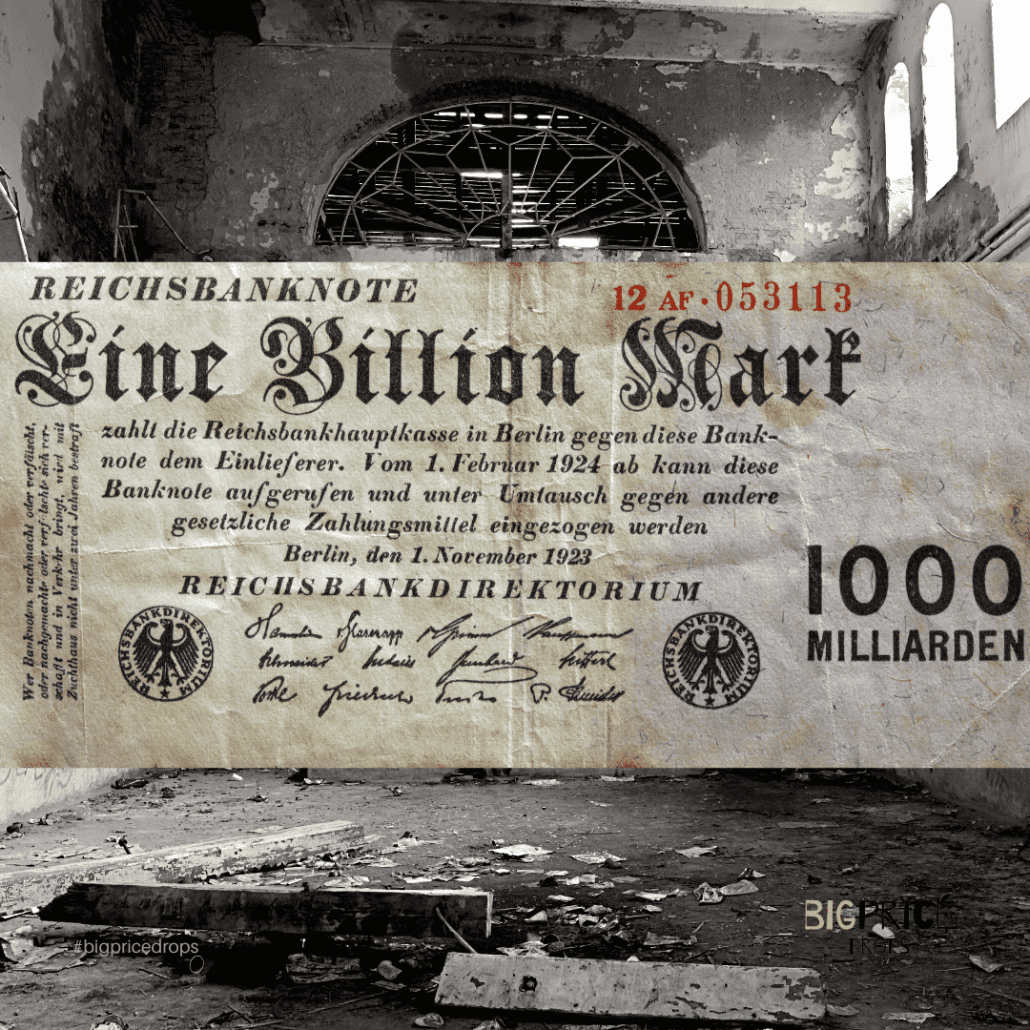
There are also potential risks of keeping fiat currency in a bank. Fiat money like Pounds Sterling is a currency that lacks intrinsic value and is established as a legal tender by government regulation and force. There is no sterling (silver) or gold backing it up. Since fiat money is not linked to physical reserves, such as a national stockpile of gold or silver, (PM Gordon Brown sold it all off at a rock bottom price in 1999) it risks losing value due to inflation or even becoming worthless in the event of hyperinflation or stagflation.
In some of the worst cases of hyperinflation, such as in Germany’s Weimar Republic (1923) and Hungary immediately after WWII, the rate of inflation can double in a single day.
As recently as 2017, the Venezuelan government’s economic policies sent the Bolivar into a downward spiral, and prices skyrocketed. The Bolivar lost 96 percent of its value at the height of the turmoil.
History never repeats itself, but it does often rhyme – Mark Twain

Preserving Wealth with Silver and Gold
So, what are the benefits of taking currency out of the fiat banking system and buying physical silver and gold? One of the main advantages is that precious metals have intrinsic value and are not subject to the same risks as fiat currency. Gold and silver have been used as a store of value for thousands of years and have proven to be a reliable hedge against inflation and economic uncertainty. They are also a tangible asset that you can hold in your hand, which can preserve wealth and provide peace of mind in uncertain times.
Another advantage of investing in physical gold and silver is that they are not subject to counter-party risk. This is important: When you deposit money, I mean currency, in a bank, you are essentially lending your money to the bank and trusting that they will repay you when you need it. However, if the bank fails, you may lose your money. With physical gold and silver, you own the asset outright and there is no counter-party risk if you keep it outside of the banking system.
In conclusion, while the FSCS provides protection for your money in the event of individual bank failures, there are still risks associated with keeping fiat currency in a bank. Investing in physical gold and silver can provide a reliable hedge against inflation and economic uncertainty, and can offer peace of mind in uncertain times. Ultimately, the decision of where to keep your money depends on your personal circumstances and risk tolerance. It’s important to do your research and make an informed decision.
Is My money Safe in the Bank 2023?

Perry Stevens is the founder of BIGPriceDrops and a long-time digital marketer with a practical interest in helping UK shoppers find better value online. He focuses on clear, no-nonsense money-saving content, Amazon UK deal insights, and buyer guides that help readers spot genuine savings without falling for misleading discounts or impulse-buy traps.
When he is not working on BIGPriceDrops, Perry runs Blend Local Search Marketing and works on digital projects covering SEO, AI tools, and online business growth. His approach is simple: help people make smarter decisions before they spend their money.


Leave a Reply
Want to join the discussion?Feel free to contribute!